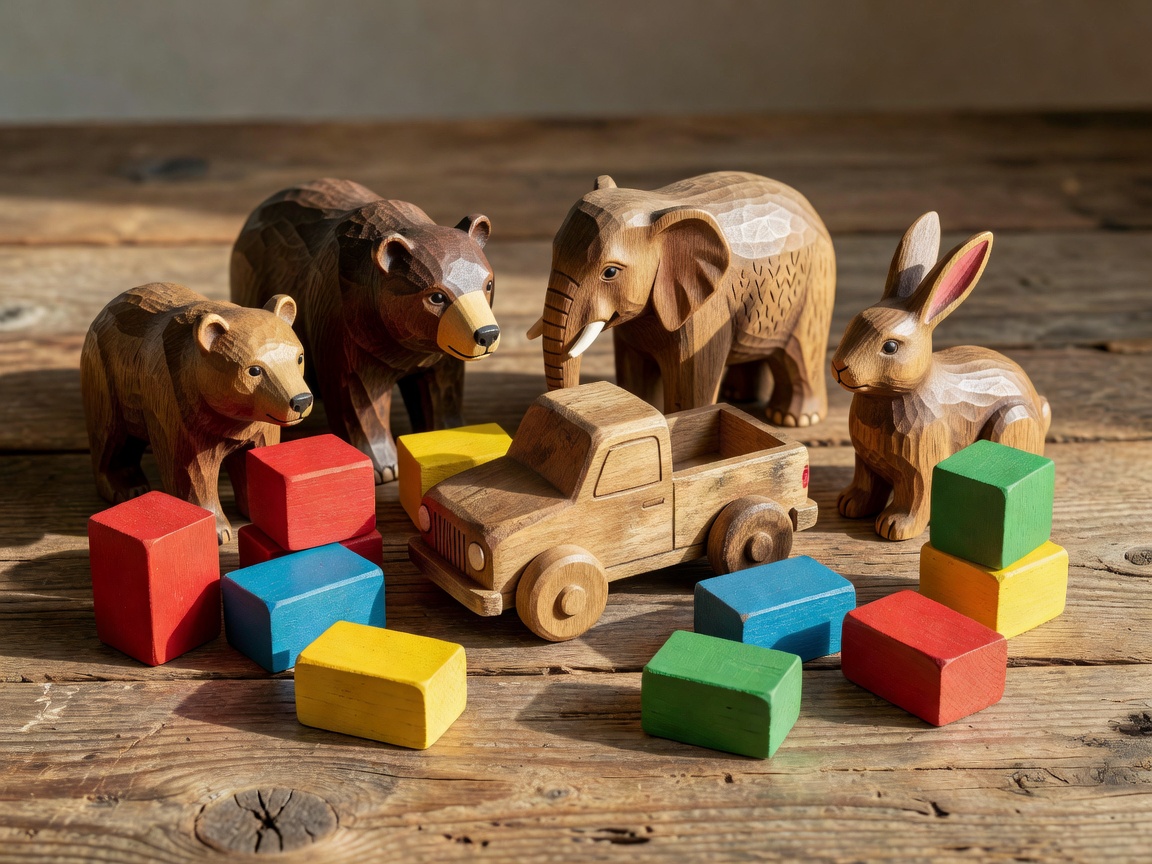
Wooden toys range from a single carved figure to a set of fitted parts. The category includes pull toys, stacking forms, balancing objects, blocks, puzzles, miniature household objects, animals and vehicles. Their shared material does not make them one design tradition. Shape, decoration and construction vary with local resources, household skills and the purpose of play.
Forms and how they work
A pull toy turns movement into play. A figure on wheels may use a simple body, axle and wheel arrangement; the design depends on how those parts relate and move. Stacking toys ask the user to compare size and balance. Blocks leave the action open: they can become buildings, boundaries or abstract arrangements. Puzzles define a more specific task through pieces that fit together.
Carved animals and wooden figures sit between representation and abstraction. A few cuts can suggest a head, body and direction without detailed features. Miniature objects may refer to tools, furniture or vehicles. Their scale invites handling, sorting or imaginative scenes.
Choosing timber
Material selection begins with the intended form. Hardwood and softwood describe broad groups, not fixed performance guarantees. Birch, beech, maple, limewood and oak differ in grain, weight, workability and surface appearance. The maker considers how a piece will be shaped, joined and finished. For a small detailed figure, a workable, even texture may matter. A broad block may call for a stable piece with a surface suited to sanding and color.
Grain is part of the design. It can emphasize the direction of a carved form or create visual variation across repeated blocks. Knots, color shifts and texture may be retained as material character or avoided where a clean graphic surface is needed. Selection should be based on the actual stock and intended construction, not the species name alone.
Construction and surface
Construction can be carved from one piece, turned into a rounded profile, assembled from components or built from repeated geometric units. A simple figure may have few joins. A vehicle needs a moving relationship between body and wheels. A stacking set depends on stable proportions. The technique should follow the form.
Surface finishing changes color, touch and visual contrast. Some objects retain visible timber; others use paint, stain or a combination. A clear surface may make grain more legible. Opaque paint can make a silhouette easier to read. Stain changes tone while allowing more grain to show. Finish behavior varies by material and product. For objects intended for children, suitability cannot be inferred from a natural appearance alone.
Traditional production and contemporary work
Traditional production often reflects available tools, local timber and household or specialist craft knowledge. Repeated forms could be shaped by hand or through established workshop processes. Contemporary makers may use those techniques, but they also work with new proportions, restrained color systems, modular parts and small-batch methods. A modern toy can quote an older form without being a historical object. Keep the distinction clear when describing provenance.
| Form | Design focus | Trade-off to consider |
|---|---|---|
| Blocks | Repeatable shape and balance | Open play relies on the user |
| Pull toy | Movement and wheel construction | More moving parts require care in design |
| Carved figure | Silhouette and tactile detail | Small features affect intended age |
| Puzzle | Fit, sequence and recognition | Specific task offers less open-ended use |
Selection criteria
- Identify the intended age and type of play.
- Look at joins, moving elements and the quality of the surface.
- Ask what timber and finish are used, and how they are maintained.
- Consider scale, weight and small-part design in context.
Good for
Wooden forms suit readers comparing construction, visual language and the relationship between a material and a play action. Blocks offer flexible use; figures and vehicles establish a more specific starting point.
What to know
Handmade describes a production approach, not a universal quality or safety level. Actual suitability depends on intended age, construction, material properties, finish, small-part considerations, applicable local requirements and appropriate product testing. This guide is educational, not a toy-safety assessment.