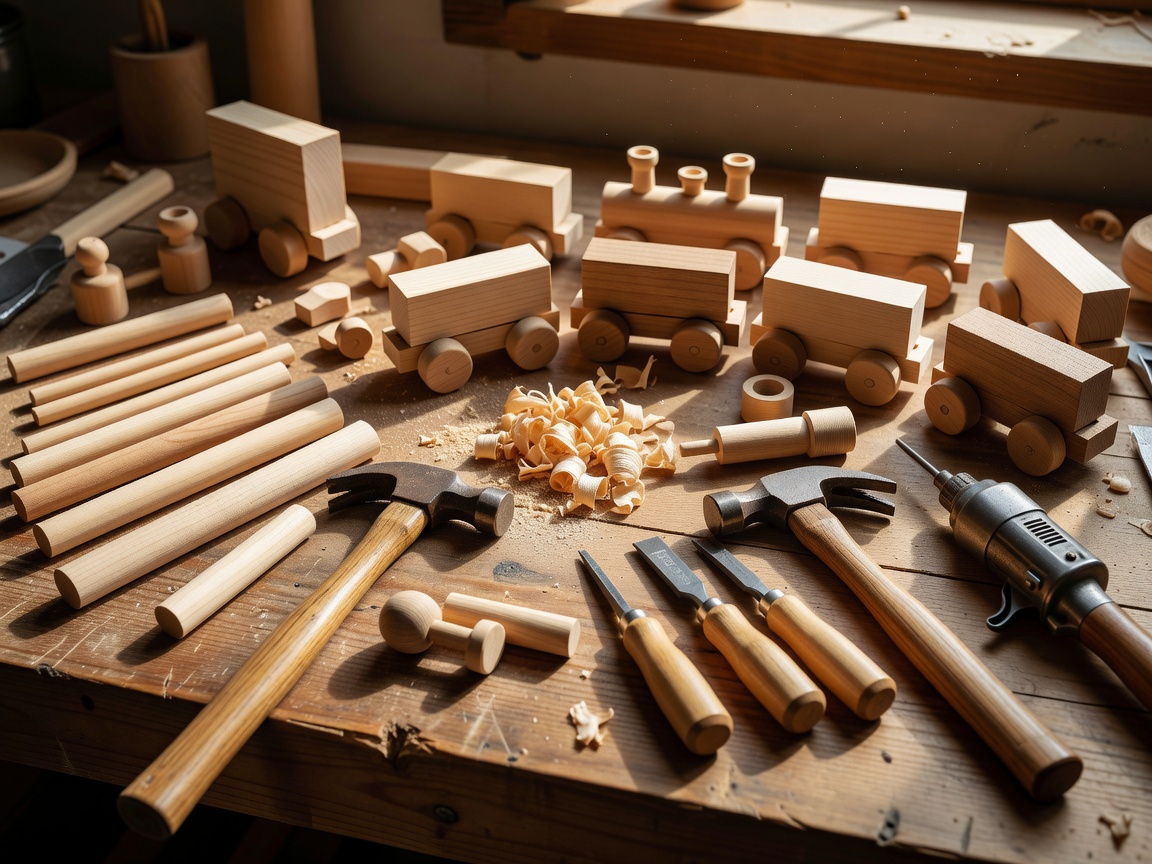
A wooden toy can be carved from one piece, assembled from several parts or shaped through a sequence of workshop operations. Technique affects silhouette, repeatability, surface and the relationship between components. The terms below describe processes at a high level. They are not tool instructions. Work with tools and materials requires suitable training, supervision and a safe setting.
Shaping the form
Carving removes material to define a figure, contour or detail. It can preserve visible tool character or create a smooth profile. The method suits forms where the maker wants direct control over an individual shape.
Whittling is a form of hand shaping in which small cuts gradually define a piece. It is associated with compact figures and simple forms. The result depends on grain, scale and the maker's approach. This guide does not provide operational instructions for cutting tools.
Turning rotates timber while a shaped profile is developed. It produces rounded, balanced forms such as spindles, beads or repeated body sections. It is useful for consistency, though the geometry is naturally suited to rotational forms.
Shaping is the wider process of creating a profile, whether through hand work, templates or workshop machinery. Sanding refines a surface and softens visual transitions. The appropriate surface depends on the design; excessive smoothing can remove useful definition or change how parts fit.
Joining and assembly
Drilling creates an opening or connection point. Its placement can determine how an axle, pin or other component relates to a body. Joining brings parts together through a designed connection. The joint may be visible or concealed and can affect both the appearance and movement of the object.
Simple assembly combines prepared parts into a whole. A block set may require little assembly. A vehicle or articulated object has more relationships to manage. Designers account for fit, movement, wear and intended handling. A join that works visually on a display object is not automatically appropriate for a toy.
Paint, stain and finish
Painting adds opaque color, line or pattern. It can clarify a figure's features or create a strong separation between parts. Staining changes timber tone while usually allowing more grain to remain visible. Results vary with species, preparation and product. A painted surface and a stained surface are not interchangeable choices.
Surface finishing describes the final treatment and feel of the object. It can protect, color or alter the tactile quality. Finish selection should account for the wood, expected use and maintenance. “Natural” or “traditional” does not by itself establish suitability for a child's product.
Hand, batch and workshop production
Hand production allows direct adjustment from part to part. It may preserve irregularities that communicate the process. Small-batch production repeats a design in limited runs, often combining hand operations with jigs, templates or workshop equipment. It can balance individual attention and consistency.
Traditional techniques describe inherited methods and forms; they do not imply that every step is unchanged or fully manual. Contemporary workshops may adapt familiar carving, turning, painting and joining to current design goals. The production description should be specific: say what is shaped by hand, what is assembled and what is repeated through a process, where that information is known.
| Process | Contribution | Consideration |
|---|---|---|
| Carving / whittling | Individual contour and detail | Form responds to grain and hand variation |
| Turning | Rounded, repeatable profiles | Best suited to rotational geometry |
| Joining | Combines parts or creates movement | Fit and durability depend on design |
| Painting / staining | Color, contrast and surface identity | Results vary by substrate and finish |
Practical selection criteria
- Choose a process that supports the required silhouette and part count.
- Consider whether visible variation or repeatable geometry matters more.
- Plan how assembly, surface and maintenance relate.
- For children's objects, seek product-specific information rather than inferring suitability from craft method.
Good for
Carving suits singular figures and irregular contours. Turning supports rounded forms. Joining creates composite objects and movement. Paint and stain give makers different ways to communicate shape and material.
What to know
Technique alone does not establish quality or safety. Actual toy suitability depends on intended age, construction, material properties, finish, small-part considerations, applicable local requirements and appropriate product testing. Seek qualified instruction before using hazardous tools.