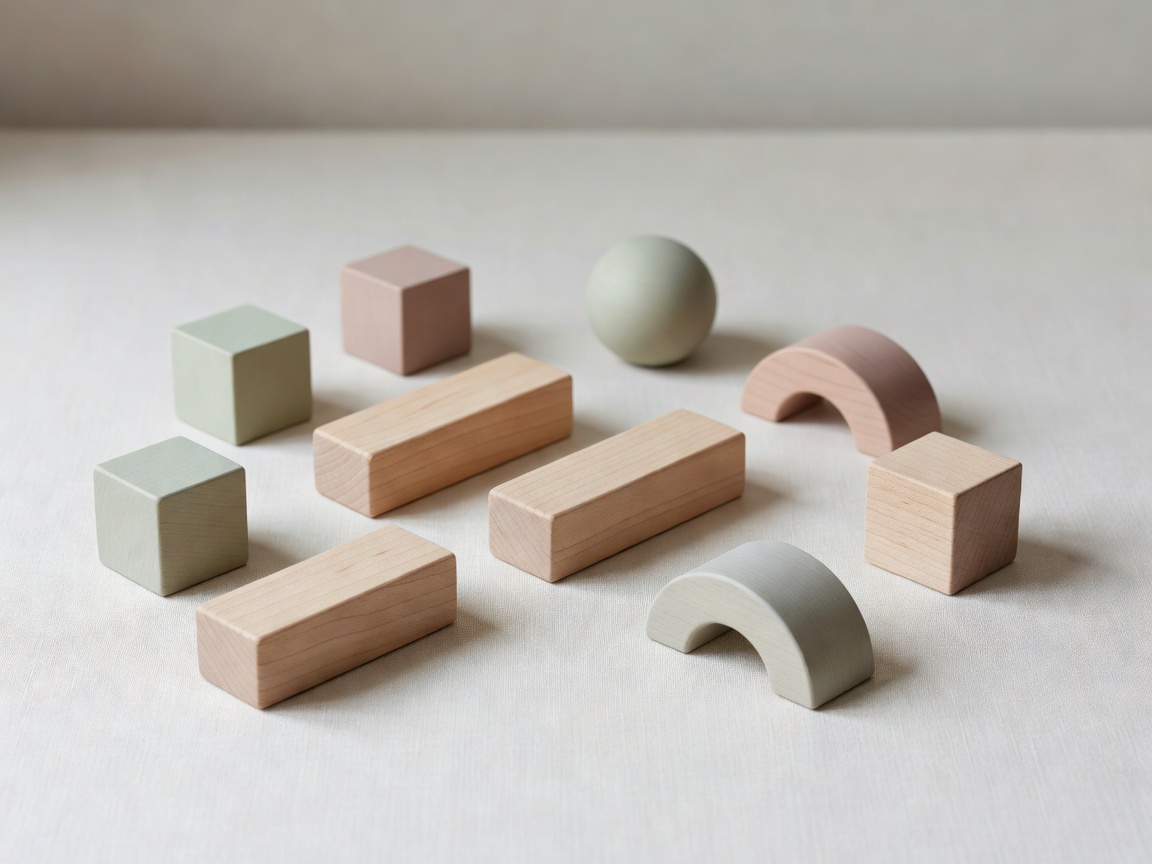
Contemporary handmade toy design often works between utility, play and sculpture. Some objects keep familiar forms such as blocks, animals or pull toys. Others reduce a toy to a small set of shapes, invite rearrangement or emphasize material and color. “Modern” describes a current design approach, not a single look or a break from history.
Traditional forms, contemporary readings
Traditional toy forms carry practical knowledge: a figure can be recognized through a few carved lines; a block set can support many arrangements; a turned form can repeat a simple profile. Contemporary makers may preserve these principles while changing scale, proportion, finish or use. A simplified animal can refer to an older carved figure without being a historical artifact.
It is useful to distinguish influence from continuity. A maker may adapt a technique, quote a silhouette or use a regional material. Those decisions do not prove an unbroken local lineage. Describe the contemporary object as an interpretation when its relationship to the past is designed rather than documented.
Open-ended, modular and sculptural
Open-ended objects support more than one imagined use. Blocks, loose forms and simple figures allow a player to decide what they represent. Modular toys use parts that combine or rearrange. The design challenge is to make relationships clear without prescribing every outcome.
Sculptural toys may prioritize silhouette, balance, color and tactile presence. That does not make them only decorative; it means the boundary between play object and designed object can be less obvious. Consider how an object is handled, moved and stored as well as how it looks in a photograph.
Material experimentation and color
Wood remains a strong material for contemporary work because it can be carved, turned, joined and left visible. Makers also combine timber with cloth, paper, clay or other materials. Each combination changes weight, texture, maintenance and construction. Material experimentation is most useful when it answers a design need rather than adding novelty.
Modern color systems often use a limited range: a natural timber base with one or two painted accents, or several muted tones arranged by part. Color can help distinguish pieces, indicate a relationship or interrupt a form. Restraint is not a historical rule; it is one contemporary choice among many.
Small-batch production and documentation
Small-batch production can combine hand finishing with repeated templates or workshop processes. That mix may support consistency while retaining visible variation. The phrase “handmade” alone does not explain how an object was made. Clear documentation identifies materials, processes, production scale and known sources without implying more than is established.
Documentation can include process photographs, material descriptions, dimensions and a clear account of what is historical reference versus new design. It should not substitute attractive imagery for useful information. For readers comparing objects, process detail makes design decisions easier to understand.
Sustainable-material considerations
Material claims need scope. A renewable material can still have impacts from sourcing, processing, transport, coatings and product life. Useful questions include where material comes from, whether waste is reduced, how parts can be repaired and what happens when an object is no longer used. Avoid broad environmental claims without evidence. A natural finish or small production run does not automatically prove a lower impact.
| Question | Traditional reference | Contemporary decision |
|---|---|---|
| Shape | Local form and practical method | Reduction, scale or new proportion |
| Material | Available regional stock | Traceability and material combinations |
| Production | Household or established workshop skill | Hand finishing with repeatable batch methods |
| Color | Surface conventions vary by place and time | Intentional palette and contrast |
Selection criteria
- Decide whether the object invites open play, a defined task or primarily visual exploration.
- Look for specific material and process information.
- Check how modules, joins and finishes relate to intended handling.
- Treat sustainability language as a claim that needs clear boundaries.
Good for
Contemporary designs can make craft methods legible through simple forms, visible grain and carefully chosen color. Modular objects reward arranging; sculptural forms emphasize shape; traditional references connect present design to older making vocabularies.
What to know
Design intent is not a safety assessment. A toy's suitability depends on intended age, construction quality, material properties, finish, small-part considerations, local requirements and appropriate product testing.