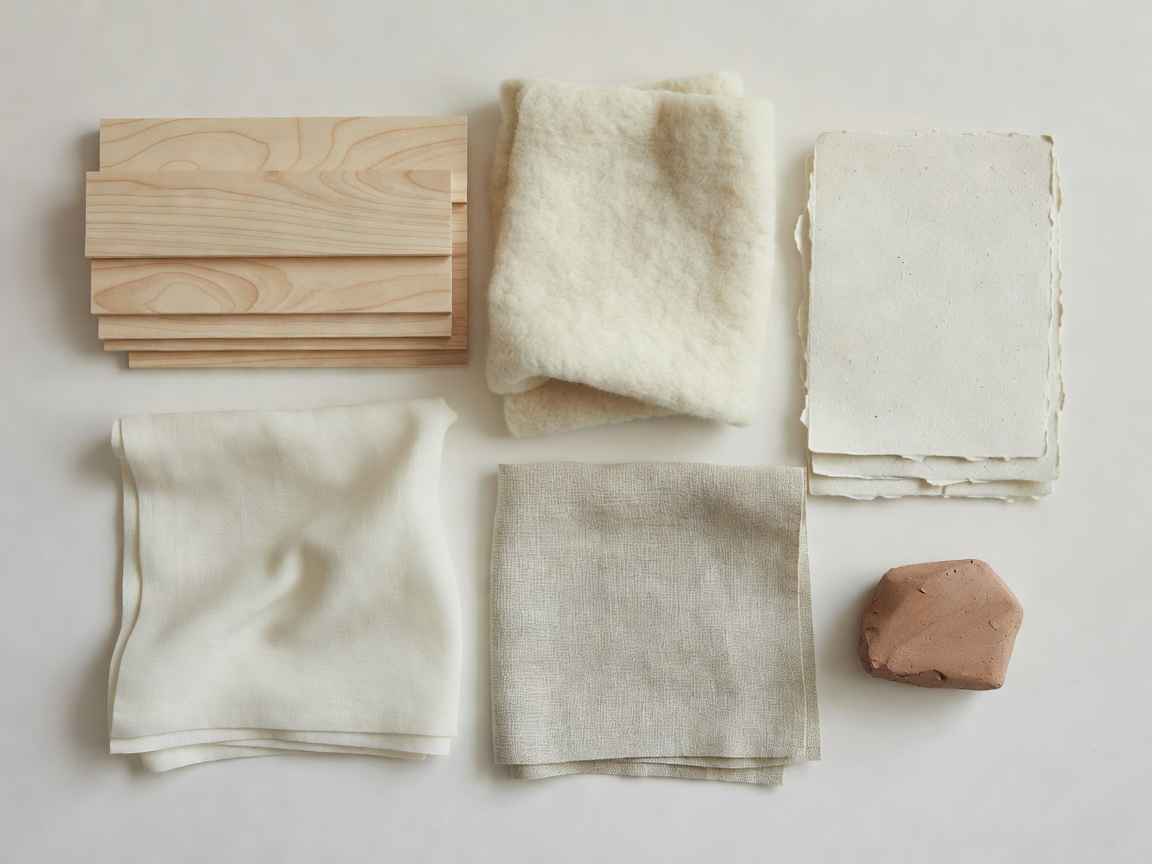
Material determines more than appearance. It affects how an object can be shaped, joined, handled and finished. Traditional toy makers worked with materials available to them; contemporary makers also consider sourcing, production scale and the intended life of an object. No material is suitable for every toy form. Selection begins with use and construction.
Wood: grain, mass and workability
Hardwood and softwood are broad categories. Species within each group vary. Birch and beech are commonly considered for their fine visual character and workable surfaces; maple can offer a pale, even appearance; limewood is often associated with carving because it can be shaped with a clear response; oak has pronounced grain and a distinctive look. These are general observations, not guarantees. Stock, moisture, cut and finish affect the result.
Grain influences both visual direction and the way a piece responds during shaping. A straight, even grain may suit a clean geometric component. A more pronounced pattern can become part of a figure or block. Weight matters when a design is meant to be held, stacked or moved. The maker balances density, intended scale, joinery and handling rather than choosing by species name alone.
Softwood may be easier to shape in some applications and can show a more pronounced grain or softer surface. Hardwood can suit parts needing a firm, refined surface, but properties vary widely. Either group needs to be assessed in the actual piece and intended design.
Textiles and flexible materials
Wool, cotton and linen support soft figures, clothing, stuffing and decorative details. Wool offers a springy, textured character in some forms. Cotton is available in a range of weaves and weights. Linen has a visible fiber character and can create a crisp, tactile surface. Fabric selection should account for weave, fraying, seam placement, colorfastness expectations and how the material changes with use.
Textiles combine easily with wood and other materials, but mixed construction needs thoughtful joining. A textile body attached to a wooden head makes a different object from a fully sewn figure. Thread, filling and small decorative parts are also part of the material system.
Paper, clay and color
Paper can be folded, layered, cut or shaped into light objects and decorative components. It is accessible and visually flexible, but its response to moisture, bending and repeated handling differs from wood. Clay can be pressed or modeled into compact shapes and has a distinct weight and surface. Its properties depend on composition and firing or drying method; no single description applies to every clay object.
Natural pigments and other colorants can produce muted, mineral or earth-toned surfaces. Their behavior depends on the binder, substrate and preparation. A material described as natural is not automatically suitable for every intended use. A finish should be selected for the actual substrate, object and use context.
Practical material comparison
| Material | Useful qualities | Limitations to assess | Often considered for |
|---|---|---|---|
| Birch / beech | Readable, relatively fine grain | Stock and finish affect result | Blocks, figures, components |
| Limewood | Responsive to shaping in suitable stock | Surface can mark; properties vary | Carved forms |
| Oak | Pronounced grain and strong visual character | Open grain may alter finish | Visible structural forms |
| Wool / cotton / linen | Flexible, layered, tactile | Weave, seams and wear matter | Dolls, clothing, soft parts |
| Paper / clay | Distinct shaping and surface options | Moisture, breakage and handling vary | Light forms, modeled figures |
How to select
- Start with the form, scale and expected handling.
- Check actual grain, weave or surface rather than relying only on a material label.
- Plan how components join and how the chosen finish behaves on the substrate.
- Consider sourcing, repair and end-of-life options without assuming a “natural” label proves sustainability.
Good for
Wood supports shaped, stacked and assembled forms. Textiles support flexible bodies and costume. Paper and clay offer different surface and modeling possibilities. Combinations add range but increase the number of interfaces to consider.
What to know
Technical properties vary with species, source, processing and finish. Material names do not establish durability or product suitability on their own. For children's products, assess age, construction, finish, small-part considerations, local requirements and appropriate product testing.